Download the Basic Education Certificate Examination (BECE) Syllabus for Basic Science and Technology to serve as a guide for educators and help candidates prepare better.

Home » BECE/Junior WAEC Syllabus For All Subjects » BECE/Junior WAEC Syllabus for Basic Science and TechnologyThe BECE Basic Science and Technology syllabus is a guide for both students and educators to use as a study guide for preparation of the BECE examination.
This syllabus covers subjects such as; Basic Science, Basic Technology, Physical and Health Education, and Computer Science.
The aim of this syllabus is to guide candidates on what to read and the study materials needed to excel in their exam. Before the exam, candidates should be able to gain a fundamental understanding of science and technology, apply scientific and technological knowledge to address modern societal needs, and they should be well equipped with essential knowledge for further studies in science and technology.
The BECE Basic Science and Technology exam consists of four compulsory papers. Paper I,II, III, and IV. Below is the breakdown of what each paper contains.
Paper I
Paper I is a 60 multiple choice questions, and it covers Basic Science, Physical and Health Education with an allocated time of sixty minutes.
Paper II
Paper II consists of 60 multiple choice questions and it covers Basic Technology and Computer Science with an allocated time of sixty minutes.
Paper III
Paper III consists of one Computer Studies practical question taken from an application package (such as CorelDraw, Paint, Instant Artist, Microsoft Word, Spreadsheet, etc.) will be included in this paper and it’s to be finished in 45 minutes.
PAPER IV
Paper IV Three required Technical Drawing (practical) problems based on basic geometric constructions from Basic Technology will make up Paper IV. The time allocated for it is 45 minutes.
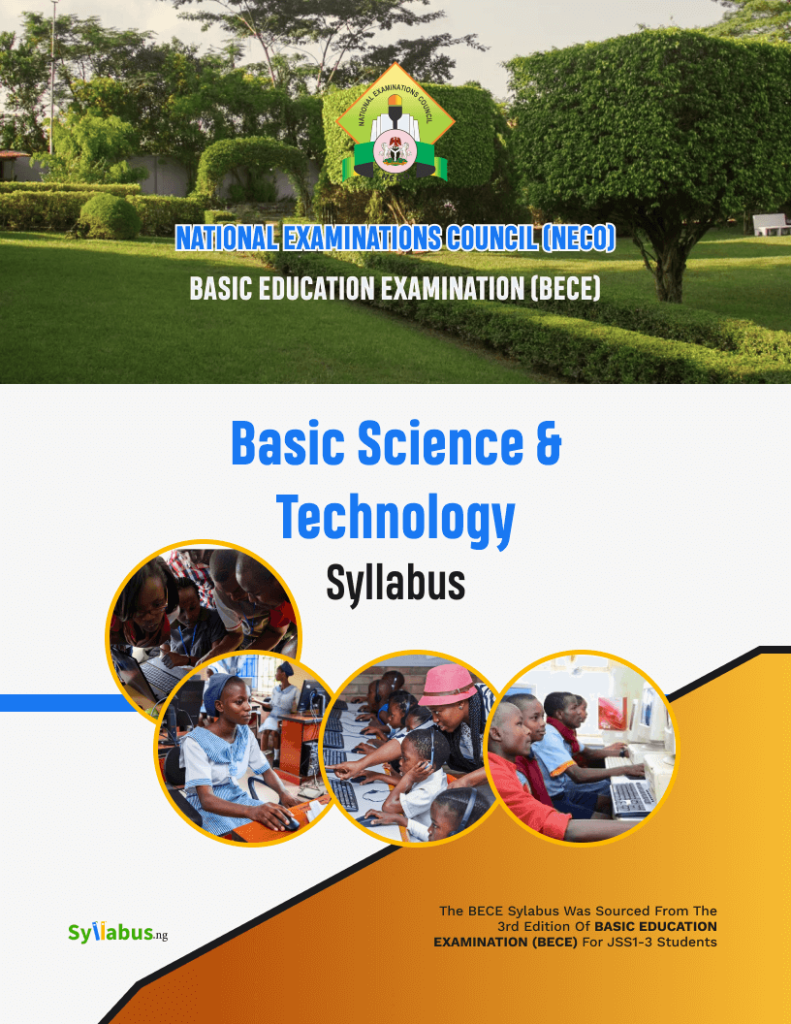
Use this NECO Basic Education Certifate Examination (BECE) Syllabus as a guide to prep your students/child in JSS3 ahead of the Basic Science & Technology exam .
Don’t be left behind. Download the Syllabus today.
| BASIC EDUCATION CERTIFICATE EXAMINATION (BECE) BASIC SCIENCE AND TECHNOLOGY SYLLABUS | |||
| S/N | TOPIC | SUB-THEME | OBJECTIVES |
| THEME: BASIC SCIENCE | |||
1 | LEARNING ABOUT YOUR ENVIRONM- ENT | I. Family Health | a. Sanitation b. Nutrition c. Drug and substance Abuse |
| II. Environmal pollution | a. Definition of air. soil and water pollution b. Causes of air, soil. and water pollution, e.g. domestic/industnal waste fertilizer/ insecticide. agricultural, chemical, non biodegradable materials, oil spillage etc. c. Consequences Ofpollution such as respiratory tract infection. uater.bome diseases. destruction of soil organisms and poor plant d. Control measures | ||
| III. Living and Non-Living Things | a. Meaning, identification and classification of matter b. States of matter c. Characteristics of living and non-living things d. Examples. characteristics and importance of plants and animals e. Differences between plants and animals f. Examples. properties, uses and importance of living and non-living things g. Classification of non-living things into metals and non-metals | ||
| IV. Living Things | a. Habitats and their examples b. Adaptation of living things to their habitat c. Relationship between organisms in the same Uniqueness of human beings: i. Reasoning ii. Problem solving iii. Observation iv. Inquisitiveness v. Measurement vi. Inference e. Measurement of growth and developmental Growth Changes in: i. Height,weight, size ii. Developmental changes; – infancy – adolescent adulthood iii. Characteristic features of stages of development iv. Classifying growth and development changes as temporal/permanent | ||
| V. Chemicals | a. Meaing of chemicals b. Classes of chemicals based on: i. Use e.g. pharmaceutical/cosmetics nuclear. industral. laboratory etc. ii. Hazardous nature e.g. highly hazardous and toxic, moderately hazardous and toxic. non hazardous and non-toxic c.Safety measures when using chemicals: i. Adhering to the manufacturer’s safety instruction ii. Follow safety guidelines for chemical storage handling iii. Observe and adhere to safety instructions on chemical packages iv. Ensure proper labelling and storage of chemicals | ||
| VI. Family Traits | a. Skin colour, height, albinism, etc. b. Meaning of dominant and recessive traits c. Importance of family traits:- i. intelligence ii. diseases iii. resemblance iv. fami ealo | ||
| VII. Environmental Hazards | a. Soil Erosion: i. Definition of soil erosion ii. Causes ofsoil erosion iii. Control of soil erosion b. Flooding: i. Drainage patterns ii. Causes of flooding iii. Prevention of flooding iv. Effects of flooding on community and farm land c. Bush Burning: i. Practices influencing bush buming ii. Effects of bush buming including economic consequences iii. Regulations against bush burning d. Deforestation: i. Reasons for deforestation, e.g. commercial and domestic fire wood ii. Effects on the environment iii. Regulations on deforestation e. Desertification: i. Definition ii. Geographical area iii. Causes, e.g.. overgrazing, bush burning. cutting trees for fire wood, etc. iv. Control measures f. Depletion of ozone layer and its effects: i. Description and location in the atmosphere ii. Importance ofozone layer iii. Effects of depletion. e.g. global warming, geen-house effect, ice melting, flooding g. Control measures: i. Regulation on use of chlorofluorocarbon (CFC); ii. Reduce bush burning iii. Control burnin in household activities. | ||
| VIII. Drug and Substance Abuse | a. Effects of drug abuse, e.g. stomach upset. skin rashes, damage nostril and lungs, injection abscess b.Prevention of drug abuse e.g. inculcating coping skills, healthy life style. positive social interactions c. Activities of drug control agencies: NAFDAC, NDLEA d. Misuse of herbal medicine | ||
| IX. Resources from living things | a. Resources from living things: i. Examples ofplant sources, e.g. cash and food crops, dyes, drugs etc ii. Examples of animal sources. e.g. hides and skin. diary products, etc. iii. Economic importance of these resources to selfand socie | ||
| X. Resources from non living things | Resources from non-living things: i. Examples-Solid minerals like coal. limestone, gold, tin etc. ii. Location in Nigeria iii. Economic improtance | ||
2 | YOU AND ENERGY | I. ENERGY | a. Meaning of energy b. Sources of energy C. Forms of energy d. Transformation of energy e. Uses of energy |
| ll. Renewable and Non- Renewable Energy | a. Reneuahle and Non-Renewable Energy i. Meamng of Renewable and Non-Renewable Energy ii. Examples Of and Non-Renewable Energy iii. Use and misuse Of renewable and non renewable energy b. Energy and society | ||
3 | SCIENCE AND DEVELOPME- NT | I. The Solar System | a. Gravitation and weightlessness b. The earth in space c. Space travel Satellite |
| II. Crude oil And Petrochemicals | a. Meaning of radioactivity b. Refining of crude Oil c. Uses of crude oil and Petrochemicals d. Importance of crude oil and petrochemicals | ||
| III. Skill Acquistion | a. Meanmg of skill acquisition b. Reasons for skill acquisition: i, taking risks ii. survival strategy iii. managmg emergency iv. learning to live together c. Types of skills:- i. farming ii. photography iii. basic computer literacy etc. d. Importance of skill acquisition:- i. improves quality of life ii. appreciate human capacity etc | ||
| IV. Ethical Issues in Science and delopment | a. Meaning of right and wrong application of science b. Implication ofbad scientific practices c. Adverse effects on a country | ||
| THEME: BASIC TECHNOLOGY | |||
| S/N | SUB THEME | TOPIC | OBJECTIVE |
| 1 | UNDERSTANDING BASIC TECHNOLOGY | I.Understanding Technology | a. Technology related professions b. Importance of technological |
2 | SAFETY | II. safety Guidelines | a. Safety guidelines for pedestrians b. Safety guidelines for cyclist/ motor cyclists. c. Safety guidelines for motorists |
| II. Workshop Safety | a. Causes of workshop accidents b. Type of workshop accidents c. Workshop safety devices d. Workshop safety rules and regulations e. Accident prevention techniques | ||
| III. First Aid | a. First Aid: Meaning and Materials b. Application of simple first aid c. ABC of First Aid: i. Air ways ii. Bleeding and breaks iii. Circulation (pulses) Application of ABC of First Aid | ||
| IV. Rescue Operations | a. Meaning of rescue operation b. Different aspects of rescue operations c. Securing the environment vehicle and victim(s) Steps involved in rescue | ||
3 | MATERIALS AND PROCESSING | I. Properties of material | a. Wood i. Identification by colour; mahogany, afara, obeche, opepe. masonia etc ii. Classification; hardwood and soft wood b. Metals i. Identification by their physical properties; e.g sound .malleability, ductility, density, lustre, ii. Classification: Ferrous and Non ferrous metals with examples iii. Forms, e.g. rods, bars, pipes.wires, plates, sheets, c. Ceramics and Glass i. Types; bricks, tiles, bottles. cups. pots etc ii. Properties; brittle, heat resistant. etc |
| II. Building | a. Common building materials: Cement, Sand. Gravel. Metal.Plastics, Wood, Glass, Leaves, Ceramics, Grass, etc b. Uses of the building materials | ||
| III. Materials and Their Common Uses | a. Wood: Fumiture, Building construction, Handles of implements. etc b. Metals: Household utensils, Vehicle and Ship parts etc c. Brass: Decorations, Ammunitions. etc d. Bronze: Carving, Statues. Ornaments, etc e. Ceramics: Tiles, Household utensils, etc f. Rubber. Tyres and tubes, Footwears, etc g. Plastic: Plastic buckets and bottles, etc | ||
| IV. Processing of i. Timber ii. Metals iii. Clay and Glass iv. Plastics and Rubber | a. Key concepts in timber processing (gowth, felling, conversion and seasoning) b. Proper uses of good timber c. Common timber defects: Twist. Bowing. Cupping. etc d. Treatment and timber preservation methods e. Importance of timber treatment a. Metal processing methods (smelting. casting. etc) b. Advantages and disadvantages of the different processing methods c. Metal alloys: Examples, Properties and Uses a. Method of processing: i. Clay ii. Ceramics iii.Glass materials b. Adiantages and disadvantages of the different processing methods c. Production and uses of clay, ceramic and glass a. Examples of plastics and rubber products b. Methods of processing plxstics and rubber c. Advantages and disadvantages of the different processing methods d. Uses of plastics and rubber | ||
4 | DRAWING PRACTICE | I. Drawing Instruments and Materials | a. Instruments and materials: Tee-square. Set square. Pair of compasses, French curves etc b. Basic techniques of handling drawing instruments and materials c. Uses of drawing instruments and materials d. Care of drauing instruments and materials |
| II. Board | a. Basic board practice: i. Setting drawing paper on the board ii. Sharpenmg pencil to conical point and knife iii. Using the Tee and Set Squares for drawing border. honzontal and vertical lines iv. Positioning and drawing the title block v. Freehand writing of letters and numerals | ||
| III. Freehand Sketching | Basic freehand techniques of drawing lines. curves, circles and irregular shapes | ||
| IV.Geometrical Construction | a. Circle: i. Parts of a circle (diameter. radius. chord. sector. quadrant, circumference, etc.) ii. Circle drawing, use of Set Squares. Tee-square and compasses to divide a circle into 4, 8 and 12 equal parts iii. Construction of tangent and normal to a circle; tangent at a point on the circle; tangent from point outside the circle and to one or two equal circles b. Triangles: i. Right angled, equilateral, isosceles and scalene triangles ii. Inscribed and circumscribed circles to given triangles. c. Polygons: Definition and construction of regular and irregular polygons: Pentagon. Hexagon, Heptagon. Octagon. using general and specific methods, etc | ||
| V. Plane Figures | a. Example of plane figures b. Construction of plane figures c. Determination of areas of regular plane figures, e.g., i. triangle and rectangle of equal areas. ii. square and rectangle of equal areas, etc d. Enlargement and reduction of plane figures: Triangles, Rectangles and Squares in given ratios by: i. length of side and ii. radial line method | ||
| VI. Isometric Drawing | a. Examples of Isometric drawings b. Isometric drawing of simple shape blocks without curves | ||
| VII. Oblique Drawing | a. Example of oblique drawings b. Simple oblique drawings | ||
| VIII. Orthogaphic Projection | a. Meaning b. Components: i. Principal planes ii. Angles of projection iii. Principal views c. Placing principal views in the quadrants d. Dimensioning techniques | ||
| IX. One-Point Perspective Drawing | a. One-point perspective drawing: i. Meaning ii. Examples iii. Principles b. One-point perspective drawing practice | ||
| X. Scales and Scale Drawing | a. Measuring and companng given sizes b. Scale drawing: i. Full size, ii. Scale reduction. e.g. l: 5, 1:10. 1:20, iii. Scale enlargement, e.g. 2:1, 3:1 etc | ||
| XL Drawing of Plans and Blue-Prints | a. Common symbols used in plans. blue-prints and their interpretations b. Identification ofbuilding components (fittings, sanitary wares e.g. sink. bath, showers; soak-away, septic tank, socket. windows, doors etc) on building plans c. Blue-print drawing techniques | ||
5 | TOOLS, MACHINES AND PROCESSES | I. Woodwork Hand Tools | a. Measuring tools b. Setting and marking out tools c. Driving tools, e.g., hammer, screw driver, mallet etc d. Boring tools, e.g., ratchet brace, bradawl. wood brace e. Holding devices f. Cutting and paring tools g. Care and maintenance of woodwork hand tools |
| II. Metalwork Hand Tools | a. Marking out tools: Surface plate, Scriber, Odd-leg caliper, etc b. Measuring tools and gauges: Steel, rule, Protractors. etc c. Driving tools: Hammer. Screw drivers. Spanners, Punches etc d. Cutting tools: Chisels, Files, etc e. Care and maintenance of metal work tools | ||
| III. Maintenance of Tools and Machines | a. Meaning of maintenance b. Types of maintenance Practices: i. Preventive ii. Corrective iii. Predictive c. Importance of maintenance | ||
| IV. Woodwork Machines | a.Types and uses:- i. Portable power tools e.g belt sander, hand drill, fret saw, etc ii. Machines, e.g., circular saw, band saw, wood lathe, surface planer, thicknesser, sander, drill. etc b. Functions of the different types of machines c. Care and maintenance of woodwork machines | ||
| V. Metalwork Machines | a. Type of metalwork machines b. Functions of the different types of machines c. Care and maintenance of metalwork machines | ||
| VI. Belt and Chain Drives | a. Examples of belt and chain drives b. Application of belt and chain drives c. Advantages and disadvanta es | ||
| VII. Hydraulic Pneumatic Machines | a. Examples ofhydraulic and pneumatic devices b. Components of the machines c. Operation and uses | ||
| VIII. Gears | a. Types of gear: Internal gear, External gear and Bevel gear b. Uses Of gears: i. Power transmission, ii. Changlng direction iii. Selecting speed c. Gear ratios and speed of rotation d. Functions of lubncants in ars | ||
| IX. Woodwork Projects | Production of various Objects using simple woodwork machines and tools. e.g., wooden tables. stools, boxes. photo frames. tee-square, pot stand. book rack, book stand, shelf. etc | ||
| X. Metalwork Projects | a. Production Of bottle Openers b. Production of tra.sh bins’cans, coal pots, etc c. Production of metal stools, chairs and benches | ||
| XI. Soldering and Brazing | a. Meaning of soldering and brazing b. Soldering and brazing tools and materials c. Operations. types and uses | ||
| XII. Machine Motions | Linear motion: i. Lever arrangement to produce linear motion ii. Use of slides and slots in mechanical systems | ||
| Xlll. Rotary Motion | Rotary motion: i. One way; e.g shaft of running ii. Reversible rotary motion. e.g. load drum of cranes, brakes, clutches and ratchets b. Principles of application c. Conversion of rotary motion to linear motion: i. Rack and pinion, Screws Crank and Slider ii. Connectin rod and iston | ||
| THEME: PHYSICAL AND HEALTH EDUCATION | |||
| S/N | SUB THEME | TOPIC | OBJECTIVES |
1 | BASIC HUMAN MOVEMENT | I. Physical Fitness and conditioning programme | a. Meaning of Physical fitness b Components of physical fitness: i. Health related components ii. Performance related components c, Olaracteristics of physically fit d. Importance ofphysical fitness e. Exercise to develop strength. endurance and flexibility f. Safety precautions while performing exercises g. Benefits derived from physical fitness h. Factors that influence physical fitness |
| II. Recreation. Leisure and Dance activities | a. Meaning of recreation, leisure and dance b. Differences among dance. leisure and recreation c. Benefits ofrecreation and dance: i. refreshment ofbody and mind ii. create room for fun and enjoyment iii. carry over values of skills leamt in physical education classes iv. promotion of mental alertness, social and emotional stability d. Indoor and outdoor recreational activities: i. Examples of each ii. Differences between the two e. Demonstration of recreational activities by the teacher, e.g. table tennis f. Explanation and demonstration of dramatic and creative rhythms,e.g. gymnastics and aerobics g. Types of dance activities h. Demonstration of different dance activities for example, bata, mpokiti/atilogwu, koros i. Demonstration of how to play computer games. g. Types of computer games as leisure activities j. Pre-colonial or folk traditional dances like: i. Atilogwu (Ibo) ii. Bata Agidigbo (Yoruba) iii. Sharo (Fulani) iv. Langa (Hausa) k. Social dances l. Foreign and modem. e.g. Reggae, Disco, High life, Rumba, classical m. Types of computer games, e.g. i. Tennis ii. Cricket iii. Soccer n. Values of computer | ||
| III. Posture and Postural Defects | a. Meaning of posture and postural defects b. Kinds of posture:- sitting, walking. lifting c. Postural defects:- kyphosis, lordosis, scoliosis, flat feet, bow legs d. Causes of postural defects: i. Poor nutrition ii. Lack of exercises iii. Poor sitting, walking and sleeping habits e. Demonstration Of appropriate | ||
| IV. Issues and challenges in physical and health | a. Issues and challenges in physical and health education b. Meaning of human trafficking c. Health implication of human traffcking on victims d. solution to human trafficking e. sport laws | ||
2 | SPORTS AND GAMES | I. Atheletic(Track and Field) Group/combined event | a. Basic skills and technique in the field event i. short put ii. discuss b. Execution of basic skills and techniques in i. discus -carriage -stance -throw -follow through ii. short put -grip -stance -put -follow through c. Rules governing discus and short put d. Safety measures e. Pole vault skills i. grip ii. run up iii. pole carrying iv. take v. hang vi. swing up vii. pull up and bar clearance viii. landing ix. recovery f. Basic javelin skills i. grip ii. carriage iii. run up iv. release v. follow through vi. recovery g. Classification as: i. Pentathlon ii. Decathlon h. Various event under: i. Pentathlon ii. Decathlon i.The duration of the competition of Decathlon and Pentathlon j. Scoring the events k. Facilities and equipment L. Rules and regulations m. Officiating n. Safety rules |
| II. Ball Games: Soccer and Volleyball | a. Basic skills and techniques in volleyball and soccer b. Application of the rules and regulation governing soccer and volleyball c. Official of the game and their functions d. Facilities and equipment e. Values of volleyball and soccer f. Common injuries in volleyball and soccer | ||
| Hockey | a. Basic skills and techniques. e.g. hit, stop, drive, dribble, pass, flick, push and bully centre pass b. Rules and safety regulations c. Officials and their duties d. Values of the gampe e. Draw and label the hockey stick and pitch f. Facilities and equipment | ||
| IV. Contact and non-contact sports | a. Definition of contact and non contact sports b. Examples of contact sports:- i. wrestling ii. judo c. Examples of non-contact Sports:- i. gymnastics ii. swimming d. Benefits of contact and non-contact sports e. Basic skills and techniques in contact and non-contact sports f. Safety measures in contact and non-contact sports | ||
| V. Contact Games | a. Taekwondo and basic techniques b. Importance of taekwondo c. Safety rules, regulation and officiating in taekwondo d. Boxing and basic techniques e. Safety rules, regulations and officiatin in boxing | ||
| VI. Non-contact | a. Swimming; i. Basic swimming style (crawl, breast stroke, back stroke, butterfly, etc.) ii. Swimming skills iii. Swimming equipment b. Gymnastics e.g. stunt, tumbling etc. c. Floor activities:- i. Classification of floor activities ii. Values of floor activities d. Officials and their duties e. Safety rules for non-contacts | ||
| VII.The Striking Games (Table Tennis, Tennis and Badminton) | a. Basic skills and techniques of striking games for example grip, service, drive, chop and smash. b. Equipment and facilities c. Rules and regulations d. Officials | ||
3 | HEALTH EDUCATION | Personal, School and Community Health | a. Determinant of health (Heredity, Environment, Life style) b. Characteristics of a healthy person c. Meaning of sewage and refuse d. Methods of sewage disposal e. Methods of refuse disposal f. Sources of water supply g. Meaning and components of school health Programme i. Skill based health education ii. School health services iii. Healthful school living healthful school environment iv. School feeding services v. School-home and community relationship h. Types of environmental pollution i. Effects of pollution on the environment and personal health j. Preventive measures against environmental pollution k. Fresh approach to school health l. Family life Education i. Meaning and types of families ii. Duties of members of the family iii. Puberty in boys and girls iv. Teenage pregnancy and its consequences v. Assertiveness and communication skills vi. Career guidance vii. Sports promotion agencies and bodies in -Nigeria Sports Associations – NAPHER. SD – Nigeria institute of sports m. Agencies/organizauons promoting health education in Nigeria. e.g.NGOs. Ministry of Health NAFDAC, WHO. etc. n. Personal Health o. Description of ageing, death p. Life enhancing measures against ageing, e.g exercise, nutrition, rest and sleep q. Supporting dying, grieving and agetng persons r. Meaning of drug use, misuse and abuse s. Categories of drugs i. Prescription of drugs’medicines ii. Non-prescription of drugs’medicine iii. Gateway Drug iv. Health consequences of drug misuse and abuse v. Ways of preventing drug abuse among young people |
| II. Nutrition and Health | a. Meaning of food b. Different types of food c. Classes and importance of food nutrients i. carbohydrate ii. protein iii. fats and oil iv. minerals and Salts v. vitamins vi. water d. Importance of food: i. eliminate hunger ii. provide energy for various physical activities iii. for health living etc. | ||
| III. Pathogens, Diseases and their prevention | a. Diseases caused by pathogens b. Disease preventÅe measures:- i. adequate nutrition and exercises clean environment iii. use of safe water iv. proper disposal of refuse and sewage v. seeking and getting treatment in time vi. good hygiene vii. immunization viii. good ventilation ix. health education x. vaccination | ||
| IV. Non- Communicable diseases and prevention | a. Meaning of non-communicable disease b. Nature of: i. Sickle cell ii. Obesity iii. Asthma iv. Anemia v. Kwashiorkor etc. c. Prevention and management of non-communicable diseases i. Sickle cell ii. Obesity and kwashiorkor etc. | ||
| VI. Family Health | a. Type of diseases and mode of transfer b. Disease vectors c. Types of disease vectors d. Life cycle of the mosquito and other vectors e. Control measures:- i. water drainage ii. insecticide iii. oil spreading’oil sprayng f Disease transmisstion g. STIs. HIV AIDS h. Consequences of contracting diseases on individual. family and socrety i. Disease prevention: i. samtauon ii. education iii. Immunisation iv. choice of life | ||
| VII. First Aid and Safety Education | a. Definition of accidents and injuries b. Safety measures i. at home ii. on the play ground iii. on the road c. Sports Injunes, causes and first aid treatment d. Domestic accident; causes and first aid treatment e. Road accidents; causes and first aid treatment | ||
| VIII. Nigerian Sports Heroes | a. Career guidance in physical education b. Past and present sports Heroes and their contributions in Nigeria c. Professionals tn physical Education in Nigeria d. Measures for preventing: l. sports Injuries ii. domestic Injuries iii. road traffic accident | ||
| THEME: COMPUTER STUDIES | |||
| S/N | SUB THEME | TOPIC | OBJECTIVES |
1 | BASIC COMPUTER OPERATIONS CONCEPTS | I. Historical Development of Computers | a. Early counting devices: i. Couries ii. fingers iii. Stones iv. Sticks v. Pebbles, etc. b. Mechanical counting and calculating devices such as: i. Abacus ii. Slide rule, etc. c. Electro-mechanical counting devices: i. John Napier bone ii. Blaise Pascal machine iii. Gottfried Leibntz machine iv. Joseph Jacquard loom v. Charles Babbage analytical machine and Philip Emagwali. d. Electronic counting devices and modem i. Herman Hollerith punch cards ii. John Von Neumann machine and modem e. Generation of computers: First to fifth generation. |
| II. Data Processing | a. Definition of data and data processing. b. Data processing cycle: i. Data gathering ii. Data collation iii. Input stage iv. Processing stage v. Storage stage and vi. Output stage. c. Importance of the computer as a tool for processing data: i. Increase accuracy ii. Efficient storage facilities iii. Fast access to information iv. Handles repetitive tasks | ||
| III. Computer Ethics | a. Computer Room Management Ethics: i. Maintaining dust-free environment ii. Appropnate ventilation iii. Appropnate lighting system and setting computer. b. Laboratory rules and regulations: i. Arrange chairs and tables in a comfortable manner ii. Arrange the computers and their peripherals in an orderly manner. c. Responsible use of Computers and internet: i. liquid dropptng into the system ii. Using dust cover iii. Protection from power problem iv. Unpluggtng the system when not in use for long v. Check youre-mail regularly vi. One prompt and polite response to mails d. Abuse/misuse of computers | ||
| IV. Computer Software | a. Definition of softuare. b. Types and examples of software: i. System software (operating system) ii. Application software (Word processing, Spreadsheet. graphics. etc) | ||
| V. Operating System | a. Definition of an operating system. b. Examples of operating systems (DOS, Window, Linux and Unix etc) c. Functions or operating system (Resource allocation, monitoring utilities) | ||
| VI. Units of Storage in Computer | The units or storage in computer include: i. Nibble ii. Byte iii. Kilobyte iv. Megabyte v. Gigabyte, etc. | ||
| VII. Computer Problem solvin skills | Computer Programmes: i. Meaning ii. Exam les(L0go . BASIC. Fortran. etc). | ||
| VIII. BASIC Programme | a. BASIC Language: i. Meaning of BASIC ii. BASIC character set b. Key BASIC statements c. Simple BASIC statement | ||
| IX. Safety Measures | a. Safety Measures: i. The sitting posture using the anti-glare protector ii. Positioning of monitor base iii. Illuminating the computer room. iv. Maintaining a dust-free environment v. Keeping liquids away from the computer | ||
| X. Computer Viruses | a. Meaning of Computer virus b. Types of Computer virus: i. Boot sector ii. Executable file virus iii. Attack on documents c. Examples of viruses: i. Trojan horse ii. Sleeper iii. Logic bomb iv. Alabama v. Virus vi. Christmas virus d. Sources Of viruses: i. Infected diskettes ii. Infected CD-ROMs iii. e-mails iv. Intemet downloads v. Illegal duplication of software. etc. e. Virus warmng signs: i. Slowing down of response time ii. Presence Of tiny dots iii. Wandering across the screen iv. Incomplete saving of a file v. Corruption of the system set-up instructions vi. Appearance of strange characters f. Virus detection (Anti-virus): i. Norton Anti virus ii. McAfee virus scan iii. Dr. Solomon’s tool kit, etc. | ||
| XI Computer opportunities | a. Computer Professionals: i. Computer managers ii. System Analysts iii. Progammers iv Computer educators v. Computer engineers and Technicians vi. Operators b. Qualities of good computer professionals c. Computer Professional Bodies: i. Nigeria Computer Society (NCS) ii. Institute of Management Information system (IMIS) iii. Computer Professional Registration Council of Nigeria (CPRN) iv. Nigerian Internet Group (NIG) v. Information Technology Association Of Nigeria (TAN), etc. | ||
2 | BASIC KNOWLEDGE OF INFORMATION TECHNOLOGY | Application of IT in everyday life | a. Uses of IT: i. Communication ii. Timing and control iii. Information processing/management b. IT and society |
| II. Information Transmission | a. Meaning of information transmission. b. Ancient methods of transmitting information: i. Oral ii. Beating drums iii. Fire lighting iv. Town crying v. Whistling vi. Drawing diagram vii. Making representation, etc. c. Modem methods of transmitting information: i. Prints ii. Telephone iii. Telex vi. Radio v. Television vi. Fax vii. Satellite viii. Intemet ix. GSM,etc. | ||
| III. IT as a Transfomational Tool | a. Meaning of ICT (Information and Communication Technology). b. Examples• i. Computers ii. Telephone (GSM) iii. Satellite communication iv. Cellular network v. Television vi. Intemet etc. c. Benefits of IT Gadgets, d. Disadvantages of IT Gadgets | ||
| IV. IT Gadgets | a. The GSM b. Fax Machine c. Telphone, etc | ||
| V. Intemet | Definition Of terns: i. Internet (The largest Computer network in the world) ii. e-mail address iii. World wide web (www•) b. Internet browser. i. Microsoft intemet explorer ii. Netscape, Mozflla, etc. c. Creating e-mail account d. Benefits of intemet : i. Information exchanges ii. e-leaming iii. e-commerce iv. e-entertainment v. Faster and cheaper e. Abuses of intemet: i. Fraud ii. Pornography f. Examples Of search engines• i. Google.com ii. Mama.com iii. Ask.com. iv. Yahoo.com etc. g. Uses of search engines h. Characteristic features of internet i. Uses of Internet j. Network groups | ||
| VI. Digital Device | a. Concept of digital device b. Features of Old Economy: i. Time consuming ii. Labour based iii. Mechanical iv. Constrained by space. time and distance etc c. Features of New Economy: i. Digital ii. Time. space and distance is irrelevant iii. Technology driven iv. Knowledge based. etc. d. Limitation of the old economy e. Benefits of new economy: i. Low capital to start business ii. Creates new jobs. etc. | ||
3 | COMPUTER APPLICATION PACKAGES | I. Word Processing | a. Examples of Word Processing packages (Microsoft Word AmiPro and professional write, etc.) b. Uses of word processor like: i. Creating text document ii. Loading an existing Microsoft word iii. Creating files iv. Saving v. Retrieving files, etc. |
| II. Graphic Packages | a. Meaning of graphic package b. Examples of graphic packages (Paint, Coreldraw, Instant artist, Auto-card. etc). c. Features: i. Tool bar ii. Menu bar iii. Printable area iv. Colour palette, etc. | ||
| III. Paint Environment | The paint: i. Paint environment ii. Paint tools and their functions. | ||
| IV. Spreadsheet Packages | a. Examples of spreadsheet package (Excel. Lotus 123. STATVIEW. etc.) b. Uses of spreadsheet packages: i. Preparation of budget ii. Exarntnatton result iii. Preparation of dally sales c. Spreadsheet features and terminologies (Row, column. cell, worksheets, charts. data range, etc.) d. Loading and exiting spreadsheet packages | ||
| V. Worksheet | a. Worksheets (starting worksheet. data entry. editing. saving. retneving worksheet. formatting worksheet. e.g.. text, cell and columns etc;) b. calculation (addition. average counting. multiplication. division, etc.) c. Printing of worksheet | ||
| VI. Database | a. Database Terminologies: i. Fields ii. Records iii. File iv. Database v. Key. etc. b, Forms of Database: i. Flatfile ii. Hierarchical iii. Relational. etc. | ||
| VII. Graph | a. Creating graph: i, Line graph ii. Histograms iii. Pie-charts iv. Legends, etc. b. Editing graphs c. Formatting graphs: i. Line graph ii. Histograms iii. Pie-charts iv. Legends, etc. | ||
The grades that were used are A, B, C, P, and F. They will be listed below in order of merit.
SN | SCORE | GRADE |
1 | 70-100 | Distinction |
2 | 60-69 | Very Good |
3 | 50-59 | Credit |
4 | 40-49 | Pass |
5 | 0-39 | Fail |

Physical and Health Education
Basic Science and Technology
Use this NECO Basic Education Certifate Examination (BECE) Syllabus as a guide to prep your students/child in JSS3 ahead of the Basic Science & Technology exam.
Don’t be left behind. Download the Syllabus today.