Home SSS1 Scheme of Work SSS1 Geography Scheme of Work

SSS1 Geography of Work

Download the Senior Secondary School 1 (SS1) Unified Scheme of Work for Geography to serve as a guide for educators. SS1 is also written SSS1.

Download Now!

SSS1 Geography of Work

About SS1 Geography Scheme of Work

Geography as a subject encompasses the study of the Earth's landscapes, environments, and the interactions between people and their surroundings. It is typically divided into two main branches: physical geography and human geography.

Physical Geography focuses on the natural environment, including the study of landforms, climate, vegetation, water bodies, soils, and natural phenomena. It investigates how physical processes such as weather, tectonic activity, and erosion shape the Earth's surface. On the other hand, Human Geography examines the relationships between people and their environments. It covers topics such as cultural landscapes, urban development, population distribution, economic activities, and the impact of human activities on the environment.

Geography in SSS1 (Senior Secondary School 1) lays a crucial foundation for students beginning their exploration of the world's physical and human landscapes. The unified scheme of work includes various topics, such as physical geography, which explores landforms, climates, and ecosystems, and human geography, which looks at population dynamics, urbanization, and economic activities. 

By studying Geography in Senior Secondary School 1 using the Lagos state unified scheme of work, students understand the complex connections between natural environments and human societies, preparing them for more advanced geographical studies in the future.

Assessment Guide

In senior secondary school 1, students are assessed in Geography based on the school’s prerogative. However, typically, they are evaluated through tests or quizzes (Continuous Assessment Tests) and end-of-term exams.

Grading follows a scale from A to F, with A representing excellent performance, typically scoring around 70% or 80%, and F indicating failure, usually below 50% or 45%.

SSS1-geography-scheme-of-work

Download SSS1 Geography Scheme of Work

Know what's expected of you as an educator. Download the Unified Scheme of Work for Senior Secondary School One (SSS1) Geography.
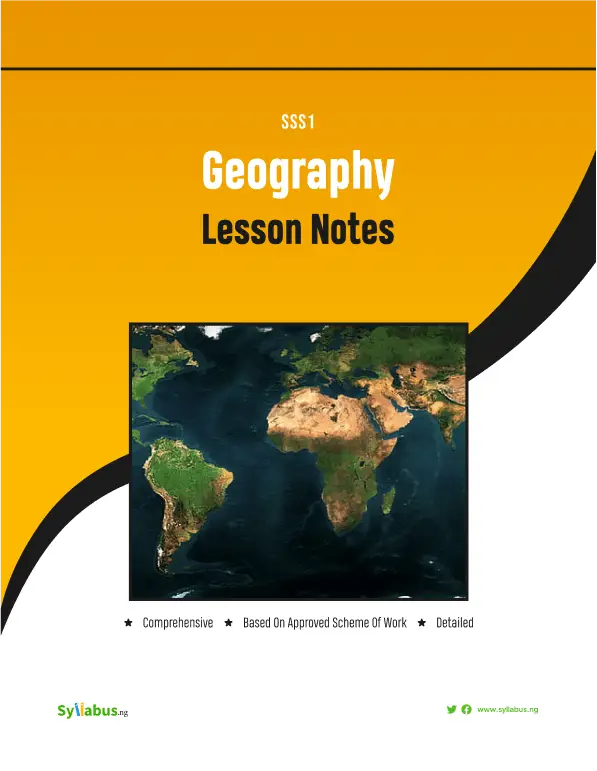
sss1-geography-lesson-note

Get SSS1 Geography Lesson Notes

Never write lesson notes from scratch again. Get our SSS 1 Geography lesson notes for First, Second and Third Term. They are printable, editable and ready to use as PDFs.

SS1 First Term Scheme of Work for Geography

LAGOS STATE MINISTRY OF EDUCATION: UNIFIED SCHEMES OF WORK FOR SENIOR SECONDARY SCHOOLSGeography Scheme of Work for Senior Secondary Schools 1(SSS1)Class S.S.S 1Subject GeographyTerm First Term
WeekTopicBreakdown
1Geography
(a) Meaning and importance
(b) The Earth and other plants
1. Meaning of Geography.
2. Value of the study of geography.
3. Components of the solar system e.g. Mercury, Venus, Mars etc.
4. The Earth:-size-shape-position in relation to the sun and other planets.
2Earth’s Rotation1. Meaning of rotation
2. Effects of rotation-day and night-deflation of word-rise and fall of tide-time differences from place to place-axis
3Earth’s revolution1. Meaning of resolution.
2. Effects of resolution:-season-marking of the year-variation in the length of day and night-equinoxes-solstice-orbit
4LatitudeLatitude:-meaning of latitude-equator.-latitude and distances-relationshipwith major regions of the world (tropic of cancer and cap acorn, arctic and Antarctic circles).
5LongitudeLongitude:-meaning-time and time zones-international dateline-grid references
6Earth’s structure1. Major spheres of the earth:
-atmosphere-biosphere-lithosphere-hydrosphere
2. Relationship between the three spheres.
3. Relevance to human activities.
4. Structure of the earth:-crust-mantle-core
7Rocks1. Types of rocks:-igneous-sedimentary-metamorphic
2. Characteristics of rocks:-structure-colour-texture-permeability
3. Mode of formation of the rock types.
4. Importance of rocks to man.
8MountainsTypes of Mountains:-volcanic-fold-block-residual
2. Characteristics of the mountain.
3. Mode of formation of the mountain types.
4. Importance of mountains:-mineral-agriculture-communication-climatic effect-etc.
9Lowlands1. Types of lowlands:-valleys-coastal-plans etc.
2. Characteristics of:-valleys-plans-coastal areas
3. Mode of formation of the lowlands.
4. Importance of lowlands.
10The Environment1. Meaning of environment.
2. Types of environment:-physical-social-cultural
3. Domains of the environment:-atmosphere-lithosphere-biosphere-hydrosphere
4. Importance of the environment.
11Revision
12Examination

SS1 Second Term Scheme of Work for Geography

Term Second Term
WeekTopicBreakdown
1Nigeria
Location and position
1. Location and position:-latitude-longitude-boundaries and neighbours
2. Size and distance-North to South-East to West
3. Political divisions
4. States and their capitals.
5. Local Government and their headquarters
2Physical setting of Nigeria Relief and drainage1. Major highlands-North-central/plateau-Eastern and North-Eastern highlands-Western uplands
2. Major lowlands
-Sokoto plains
-Chad basin
-Niger-Benue Trough
-Interior coastal lowlands
-Lowlands and scarplands of Nigeria
-Coastal lowlands
3&4Nigeria-Climate1. Air masses of Nigeria.-Tropical continental air mass (N.E. trades).-Tropical maritime air mass (S.W. monsoon)
2. Climatic belts-Tropical continental-Tropical hinterland-Sub-equatorial-High plateau (Mantane).
3. Characteristics of climatic elements in each belt.
5Nigeria Vegetation1. Broad classification
A. Forest vegetation-Salt-water (mangrove)-Fresh–water swamp-High (Rain) forest
B. Savannah-Guinea savannah-Sudan savannah-Sahel savannah
2. Characteristics of each vegetation belt
3. Importance of (a) Savannah (b) Forest vegetation.
6Nigeria-Population1. Population size distribution and structure.
2. Population quality.
3. Population movement.
4. Population data.
7&8Nigeria-Resources1. Mineral Resources-Petroleum-Gas-Coal-Tin/Columbite-Iron ore-Limestone
2. Power-Petroleum-Gas-Coal-Hydro Electric Power (HEP)-Solar energy
3. Water resources (rivers, lakes, sea, underground water).
4. Vegetation
9&10Nigeria-Agriculture1. Types of Agricultural practices:-subsistence-mechanized-pastoral farming-crop rotation-mixed farming-shifting cultivation
2. Food and cash crops.
3. Importance of Agriculture.
4. Problems of agriculture in Nigeria.
11Revision
12Examination
SSS1-geography-scheme-of-work

Download SSS1 Geography Scheme of Work

Know what's expected of you as an educator. Download the Unified Scheme of Work for Senior Secondary School One (SSS1) Geography.

SS1 Third Term Scheme of Work for Geography

Term Third Term
WeekTopicBreakdown
1&2Nigeria-Transport1. Transportation
(a) Modes of transportation:-road-rail-water-air-pipeline-aerial ropeway-human and animal portage.
(b) Advantages and disadvantages of the different transportation modes.
(c)Problems of transportation
(d) Influence of transportation on human activities
3Nigeria-CommunicationCommunication in Nigeria
(a) Communication networks-Telecommunication (e.g. telephone, services, cellular phones, voice mails etc)-Postal services-Television-Radio-News paper-Internet etc.
(b) Advantages and disadvantages of the different communication elements/network
(c) Problems of communication in Nigeria
(d) Importance of communication on human activities.
4Manufacturing industries in Nigeria1. Definition of industry.
2. Types of industries-Primary-Secondary-Tertiary-Quaternary
3. Major industrial zones.
4. Factors affecting the location of industries.
5. Problems and solutions.
6. Importance of manufacturing industries in Nigeria
5Nigeria Commercial Activities1. Major commercial activities
(a) Trade-Local-national, international-Stock exchange-Capital market-FOREX
(b) Transportation
(c) Communication
2. Major commercial areas in Nigeria
3. Importance of commercial activities
6ECOWAS1. Meaning of ECOWAS.
2. Member countries
3. Purpose/mandate of ECOWAS.
4. Advantages and disadvantages.
5. Solutions to the ECOWAS problem.
7Map Reading and Measurement of distances on maps1. Maps-Definition-Types-Examples-Uses
2. Scales and Conversion-Types-Attributes-merits and demerits of each type
3. Scale conversion
4. Measurements and units
5. Conversion
-Conversion of map distance to actual distance
-Conversion of actual distance to map distance
8Conventional symbols direction and bearing1. Acceptable symbols for feature representative.
2. The major cardinal points:-true north and magnetic north.-magnetic variation
3. Angular bearings and compass direction.
9Basic concepts of GIS1. Geographic Information System (GIS).
2. Geographic date:
-meaning/examples
-line for rivers, roads, rails, etc.
-points for boreholes, towns, farms, etc.
-sources (maps, fieldwork, satellite images, etc).
3. importance of georeferencing, geographic data and theGIS.
10Components of GIS1. Hardware components:-digitizer-Global Positioning System(GPS)-computer-printer-scanner etc
2. Software for:-data input-storage-retrieval-manipulation
3. Data:-positional-relational
4. Procedures; set of rules.
5. People experts.
11Revision
12Examination
sss1-geography-lesson-note

Get SSS1 Geography Lesson Notes

Never write lesson notes from scratch again. Get our SSS 1 Geography lesson notes for First, Second and Third Term. They are printable, editable and ready to use as PDFs.

Recommended SSS1 Geography textbooks

5 recommended textbooks. The line under each title shows which list recommends it.

NameAuthorPublisher
Essential Geography for Senior Secondary School (Tonad, latest edition)Anambra State Govt (Ministry of Education)O.A. IwenaTonad Publishers
Senior Secondary GeographySchool booklist – International School, University of Ibadan (UI-owned)S.A. EmieluGeographical Bureau Nig. Ltd.
Basic Geography Course for SS Schools Book 1School booklist – Whitesands School, Lagos (private)N.P. Iloeje, P.C. Onokala, P.O. OdemerhoLongman
Physical and Human Geography for Senior Secondary SchoolsSchool booklist – Whitesands School, Lagos (private)O. Areola, Goh Cheng Leong et al.University Press Plc
Effective Geography for Senior Secondary SchoolsSchool booklist – International School, University of Ibadan (UI-owned)Yingigba C. Jaja et al.

SSS1 Scheme of Work for All Subjects

42 subjects
  1. 1SSS1 Mathematics Scheme of WorkOpen
  2. 2SSS1 English Studies Scheme of WorkOpen
  3. 3SSS1 Civic Education Scheme of WorkOpen
  4. 4SSS1 Biology Scheme of WorkOpen
  5. 5SSS1 Chemistry Scheme of WorkOpen
  6. 6SSS1 Agricultural Science Scheme of WorkOpen
  7. 7SSS1 Physics Scheme of WorkOpen
  8. 8SSS1 Further Mathematics Scheme of WorkOpen
  9. 9SSS1 Food and Nutrition Scheme of WorkOpen
  10. 10SSS1 Technical Drawing Scheme of WorkOpen
  11. 11SSS1 Physical Education Scheme of WorkOpen
  12. 12SSS1 Health Education Scheme of WorkOpen
  13. 13SSS1 Information Technology (IT) Scheme of WorkOpen
  14. 14SSS1 Biology Scheme of WorkOpen
  15. 15SSS1 Building Construction Scheme of WorkOpen
  16. 16SSS1 Woodwork Scheme of WorkOpen
  17. 17SSS1 Financial Accounting Scheme of WorkOpen
  18. 18SSS1 Office Practice Scheme of WorkOpen
  19. 19SSS1 Economics Scheme of WorkOpen
  20. 20SSS1 Commerce Scheme of WorkOpen
  21. 21SSS1 Government Scheme of WorkOpen
  22. 22SSS1 Literature in English Scheme of WorkOpen
  23. 23SSS1 Economics Scheme of WorkOpen
  24. 24SSS1 Geography Scheme of WorkYou are here
  25. 25SSS1 History Scheme of WorkOpen
  26. 26SSS1 French Scheme of WorkOpen
  27. 27SSS1 Music Scheme of WorkOpen
  28. 28SSS1 Yoruba Scheme of WorkOpen
  29. 29SSS1 Igbo Scheme of WorkOpen
  30. 30SS1 Hausa Scheme of WorkOpen
  31. 31SSS1 Visual Arts Scheme of WorkOpen
  32. 32SS1 ArabicOpen
  33. 33SSS1 Islamic Religious Studies (IRS) Scheme of WorkOpen
  34. 34SSS1 Christian Religious Studies (CRS) Scheme of WorkOpen
  35. 35SSS1 Animal Husbandry Scheme of WorkOpen
  36. 36SSS1 Book Keeping Scheme of WorkOpen
  37. 37SSS1 Data Processing Scheme of WorkOpen
  38. 38SSS1 Store Keeping Scheme of WorkOpen
  39. 39SSS1 Catering and Craft Scheme of WorkOpen
  40. 40SSS1 Machine Wood Work Scheme of WorkOpen
  41. 41SSS1 Marketing Scheme of WorkOpen
  42. 42SSS1 Data Processing Scheme of WorkOpen
error: Content is protected !!
Download Syllabus