NECO Igbo Language Syllabus
Are you writing Igbo Language in your NECO O’level exams? Download the recommended Igbo Language syllabus to excel in your exams.

Home » NECO Syllabus » NECO Igbo Language SyllabusAbout NECO Igbo Language Syllabus
The Igbo syllabus is designed for anyone who wants to take the NECO Igbo examination and become proficient in the Igbo language and learn about the vibrant culture of the Igbo people. By following this syllabus, you’ll gain the skills to speak, read, and write in Igbo with confidence.
The syllabus is comprehensive. It includes everything from the basics of the Igbo sound system and grammar to Igbo customs and institutions. You’ll get to learn about the different aspects of the Igbo language, like how to pronounce words correctly and structure sentences. Plus, you’ll explore Igbo culture, which will give you a better understanding of the people and their way of life.
If you religiously study this syllabus, you will be well-equipped enough to pass your exam in flying colours.
Marking Guide & Sections
The exam has two parts, Papers 1 and 2, which are taken at one sitting. All questions and instructions are in Igbo, and you must answer using the correct Igbo orthography and meta language. Here’s what to expect in this exam:
PAPER 1: Multiple Choice
This paper consists of 60 multiple-choice questions divided into three sections: Section A: Language, Section B: Literature, and Section C: Culture. You have 1 hour to complete this section, and it carries a total of 60 marks.
Section A: Language
This section has 30 questions on various aspects of the Igbo language:
Comprehension: You will be required to read two short passages and answer 10 questions.
Composition/Letter Writing: There are 4 questions about structuring written texts.
Sound System: These 6 questions focus on pronunciation and phonetics.
Grammar: Another 6 questions test your knowledge of Igbo grammar rules.
Translation: You’ll translate words or phrases in 4 questions.
Section B: Literature
This section has 22 questions covering various aspects of literature:
Basic Principles of Literary Appreciation: These 4 questions test your understanding of key literary concepts.
Oral Literature: A total of 9 questions are split into: prose (3), poetry (3), and drama (3).
Written Literature: Another 9 questions, similarly split among prose (3), poetry (3), and drama (3). These questions are based on the set books for Paper 2.
Section C: Culture
The final section has 8 questions about Igbo culture:
Customs: Four questions are set about traditional practices and societal norms.
Institutions: Four questions are set about cultural institutions, like family structures and community roles.
PAPER 2: Composition
This section has 13 questions covering Language, Literature, and Culture. You must answer six out of the thirteen questions. This paper has 100 marks and you have 2 hours to complete it.
Section A: Language
In this section, you’ll write about language-related topics. It could involve essays, narratives, or letter writing. When writing, you should focus on clear structure, proper grammar, and correct use of the Igbo language.
Section B: Literature
In this section, you will be asked questions about literary analysis, you might discuss themes, characters, or settings in set books, or analyze poetry or drama. Be sure to reference specific examples from the texts to support your answers.
Section C: Culture
This section requires you to write about Igbo culture, including customs, traditions, and institutions. You might be asked to describe a particular cultural event, tradition, or practice, so draw on your knowledge and experience.
Marking Guide
Marks for Paper 1 are straightforward,each multiple-choice question is worth one mark, with a total of 60 marks available.
For Paper 2, the marking will be based on several factors:
Content: Does your answer address the question and provide relevant information?
Structure: Is your answer well-organized and easy to follow?
Language Use: Are you using correct grammar, punctuation, and orthography?
Creativity and Insight: Do you bring fresh insights or creativity to your answers?
Download NECO Igbo Syllabus
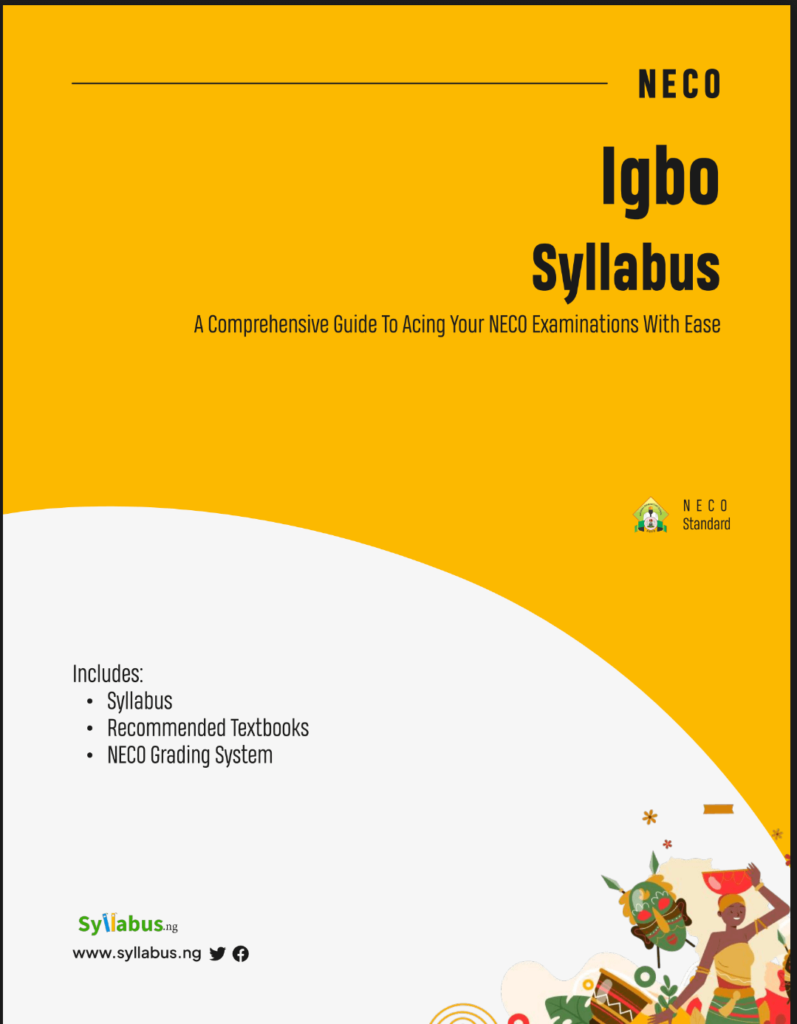
Best candidates excel because they study smart and hard. Know what’s expected of you.
Download the NECO recommended Igbo syllabus.
The NECO Igbo Language Syllabus
SN | IGBO | |
| SECTION A:ESSAY | ||
| TOPICS | OBJECTIVES | |
| 1 | Part I: Composition/ Letter Writing | Candidates are advised not to spend more than 45 minutes on this section. There will be five topics from the following essay types and candidates will be expected to write on one of them in about 300 words: (1) Narrative; (2) Descriptive; (3) Argumentative; (4) Expository; (5) Dialogue; (6) Debate; (7) Letter writing |
| 2 | Part II: Sound system | Two questions will be set for candidates to answer one of them. The questions will test candidate’s basic knowledge of the following areas: (a) Igbo Phonemes: Vowels, Consonants, the Syllabic nasal, (i) their production, and (ii) their classification. (b) Syllable Structure. (c) Sound Processes: vowel harmony, vowel assimilation, vowel elision and consonants elision. (d) Tone and tone notation. (e) The Igbo alphabet. |
| 3 | Part III: Grammar | Two questions will be set for candidates to answerly one of them. The questions will test candidate’s knowledge of the following areas: (a) Spelling rules. (b) Word formation. (c) Igbo dialects and Standard Igbo. (d) Loan words. (e) Igbo metalanguage (new words). (f) Word classes: The noun, verb, pronoun, conjunction, preposition, etc. (g) Grammatical categories: tense, number and person. (h) Phrases and Clauses: their types and functions. (i) Sentences: i. their constituents and types. ii. Sentences containing Direct and Indirect Speech. (j) Lexis and Structure. (k) Punctuation marks. |
| Section B: Literature | ||
| Part I: Oral Literature | Three questions will be set for this part and candidates will be required to answer only one of them. All questions in this section will be based on the prescribed texts. In this part, candidates will be required to have basic knowledge of the following: (a) Definition and characteristics of oral Literature (b) Classification and functions (c) Literary devices (d) Folktales (ifo) (e) Anecdotes (ụkabụilu) (f) Legends (nk kịrị kọ/akụkọ dike) (g) Myths (nkọmịrịkọ/akụkọokike/mmalite) (h) Poems (abụ) (i) Songs (uri) (j) Proverbs (ilu) (k) Riddles (agwụgwa) (l) Chants (mbem) (m) Oral drama (ejije ọnụ) (n) Tongue twisters (okwuntụhi) | |
| Part II: Written Literature | Three questions will be set for this part and candidates will be required to attempt only one. All questions in this section will be based on the prescribed texts. | |
| Section C:Culture | ||
| 1 | Customs – Omenala | (a) i. Njirimara ndị Igbo-asụsụ, ejiji, omenala, ekpemekpe , agbambọ, dg. ii. Ekele ndị Igbo n’oge dị icheiche. (b) Mmemme -ọjị, ịtụ nzụ, ịkwọ aka ụtụtụ, ịgọ ọfọ, dg. (c) Nnabata ọbịa. (d) Ọmụmụ nwa – ile ọmụgwọ, ibi ugwu, ikupụta nwa, ịgụ aha, ịzụ ahịa nwa, ịhụ eze, dg. (e) Nkwenye – ịlọ ụwa, ọgbanje, nrọ, ihi/isi anụ, ịha/ịchụ mmiri, dg. (f) Emume – ọfala, ịbọ ụzọ, ịwa ji/iri ji, igbu ewuukwu,iru mgbede, ịwa akwa, akwamozu, ịgba mkpe, ịgụ afọ, mbarị, ụdara, dg. (g) Egwuregwu – egwu ụmụaka, ịgba/ịchụ oro, ịtụ okwe, ịzụ nchọrọkọtọ, ịkpọ okwe, mgba, ịkpọ ọga, okoso, egwu ọnwa, dg. (h) Nsọala/Arụ – ihensọ, ebensọ, anụnsọ, osisinsọ, ime ibeeṅe. |
| 2 | Institutions – Ewumewu | (a) Ewumewu ọchịchị – ezinaụlọ, ndị eze ọdịnala, nze na ọzọ, ụmụọkpụ/ụmụada,otu ọgbọ, otu nzuzo, otu inyomdi, ụmụnna, ogbe, obodo. (b) Ewumewu mmekọrịta mmadụ na ibe ya – alụmalụ, ezinaụlọ, ịgọ ọgọ, nwanwa/nwadiala, ịgba ndụ, ịgba orikọ (c) Echichi – Lọọlọ, Iyọm, Ọmụ, Ezeji, Jioke, Atama. (d) Abamaba – Mmọnwụ,Ọkọnkọ, Ekpe, Ọmabe, Odo, Dibịa. (e) Ewumewu akụnaụba – ike ekpe, iri ekpe, ala na ihe dị na ya. (f) Akaọrụ – ịkpụ ụzụ, ịgba nta, ịkụ azụ, ọrụugbo, ịkwa nka, ịkpụ ite, dg. (g) Ewumewu ofufe – ịgba afa, ịchụ aja, dg. (h) Ngwa ofufe – ọfọ, ikenga, okpesi, ogu, ọtọnsi , dg (i) Ihe ofufe – Ndịichie, Arụsị, Ikenga, Ala, Mmụọ mmiri, Arụsị/ Agbara dịka Ogwugwu, Ahịajiọkụ, Agwụ, Amadịọha, Kamalụ, Agbala, Ibini Ụkpabị, Ojukwu, Igwekaala, Idemmili, dg. |

Recommended NECO Igbo Language Textbooks
WRITTEN LITERATURE
1. PROSE
Ton Ubesie JVQ Obinna, University Press PLC, 1993
2. DRAMA
J.C Madvekwe, Otu MK isi Aka, Longman Nigeria( Learn Africa), 1979
3. POETRY
Inno Vzoma Nwadike, Akunuche, Pacific College Press Ltd, Obosi 2014
Abu Ndi A Hupotara (Selected Poems
Ochichi 40-41
Onye Ndu 53-55
Nne Oma 60-61
Oke OchichQ 62-63
Asila M Na Q Di Mma 65-66
Ihe Vwa 67-69
Jiri NwayQQ 92-94
Eziokwu 101-103
Mma 108-111
Nwaanyi 11 131-132
Ala Igbo 150-151
Nd!1 M N’vwa A 151-154
OJI 168-169
Eluvwa By Qiili 98-100
Nwa Amaka 112-113
Egwu Orimado 113-114
Ihe Di Mma 121-122
O Rule, O Rule 123-124
Ma Q Bughi Ma Nwa 126-127
Onye W Enyi Qnwy? 141-142
ORAL LITERATURE
1. AKOMAKO
F.O.F Onwudufor, Mbe A Aba, Aka On Publishers: Akwa, 2014
2. POETRY
G.I Nwaozuzu, Abu Agurvnqnv Ndi I bo, Univcersity of Nigeria Press Ltd: Nsukka, 2020
Abu Ndi A Hoputara( Selected Poems)
Utll Chara N’elu 4-6
Otu Ibiri
Nnabe Akvwaala Akwa 9-12
Onye Kvgbu Nwankelu 13-15
Agbagbuo M Nwannunv 19-23
Onye KQQ Ji 28-29
Anyi Agawa Mba 33-34
Nnabe Agawa Nga EbuleakQ 38-41
Q Sara Anya 46-47
Mgbe O Suru 60-61
Aluo M Di Poliis 87-88
A Di
Ndi Biara Ije Unu Were 95-98
Eluvwa By Qiili 98- 100
Nwa Amaka 112-113
Egwu Orimado 113-114
Ihe Di Mma 121-122
O Rule, O Rule 123-124
Ma Q Bughi Ma Nwa 126-127
Onye W Enyi Qnwy? 141-142
All NECO Syllabus
Frequently Asked Questions About the NECO Igbo Language Exams
Download NECO Igbo Syllabus
Best candidates excel because they study smart and hard. Know what’s expected of you.
Download the NECO recommended Igbo syllabus.