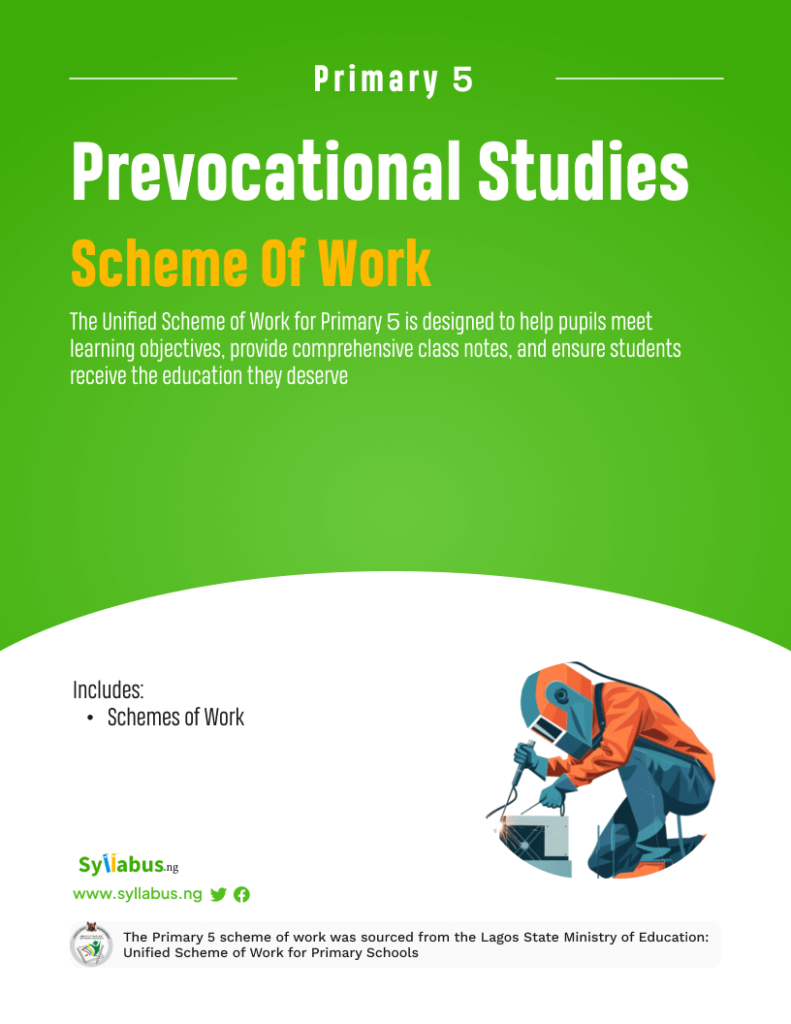
Download the Lagos State Unified Scheme of Work for Primary 5 Prevocational Studies to serve as a guide for educators and primary school teachers.

Home » Primary 5 Scheme of Work » Primary 5 Prevocational Studies Scheme of WorkPrevocational Studies is a subject that prepares the pupils for advanced vocational courses. This subject comprises two subjects; Agriculture and Home Economics with each having its topics and objectives to achieve.
Some of the topics covered in this class include; Crop Production, planting and post-planting activities, preservation of harvested crops, family, roles of each family member, simple basic tools and equipment, basic stitches etc.
By the end of the academic session, the pupils should have been able to Cultivate crops on their own, harvest cultivated crops, raise any farm animal of their choice, practice basic sewing stitches etc.
Know what’s expected of you as an educator
Download the Lagos State Unified Scheme of Work for Primary 5 Prevocational Studies
| LAGOS STATE GOVERNMENT MINISTRY OF EDUCATION UNIFIED SCHEMES OF WORK FOR PRIMARY SCHOOLS | ||
| Prevocational Studies Scheme of Work for Primary/Basic 5 | ||
| CLASS | Primary/Basic 5 | |
| SUBJECT | Prevocational Studies | |
| TERM | First Term | |
| WEEK | TOPICS | Learning Objectives |
| 1(Agriculture) | Review of primary four scheme of work | By the end ofthe lesson, pupils should be able to: i. recall previous topics taught in primary 4. |
| (Home Economics) | Resumption test/Revision of last terms/ session work: -meaning and scope of Home Economics | By the end of the lesson, pupils should be able to: i. discuss the meaning of Home Economics; ii. outline the importance of Home Economics to the society; iii. state the areas of Home Economics. |
| 2(Agriculture) | Crop production | By the end of the lesson, pupils should be able to: 1) define crop production; 2) identify different types of crops; 3) classify crop based on uses, life cycle and morphology. |
| (Home Economics) | Family : meaning and types of family | By the end of the lesson, pupils should be able to: i. explain the meaning of family; ii. discuss types of family; iii. compare and contrast the features of each family types. |
| 3(Agriculture) | Procedures for crop production. | By the end of the lesson, pupils should be able to: 1) outline procedures for cultivating crops; 2) identify pre-planting activities; 3) carryout pre-planting operations on the farm, |
| (Home Economics) | Roles of each family members and functions of the family | By the end of the lesson, pupils should be able to: i. identify the roles of each family members; ii. summarize the roles of each family members; iii. evaluate the functions of family. |
| 4(Agriculture) | Planting Activities | By the end of the lesson, pupils should be able to: 1) describe planting activities; 2) identify tools used in planting activities; 3) carryout planting activities on the school farm and at home. |
| (Home Economics) | Family relationship and famiiy tree | By the end of the lesson, pupils should be able to: i. describe family relationship; . ii. justify the reasons for family bonding; iii. draw their family tree. |
| 5(Agriculture) | Post-planting activities; irrigation, mulching, thining, supplying, of manure/fertilizer and weeding | By the end of the lesson, pupils should be able to: 1) explain post planting activities; 2) outline examples of activities done during post planting; 3) demonstrate fertilizer applicatation on farm crops. |
| (Home Economics) | Identification of simple cooking tools and equipment. | By the end of the lesson, pupils should be able to: i. identify simple cooking tools and equipment; ii. enumerate simple cooking tools and equipment; |
| 6(Agriculture) | Harvesting activities | By the end of this lesson, pupils shoåld be able to: 1) describe the steps involved in harvesting crops; 2) enumerate tools used in harvesting crops; 3) recognize the right time for harvesting crops. |
| (Home Economics) | Guidelines for use of cooking tools and equipment. | By the end of the lesson, pupils should be able to: i. distinguish between cooking tools and equipment; ii. itemize the use of each cooking tools and equipment. iii. state the guidelines for use of cooking tools and equipment. |
| 7 | Mid Term Test and Break | |
| 8(Agriculture) | Post harvesting activities; sorting grading and storage | By the end of this lesson, pupils should be able to: 1) explain post harvesting activities; 2) outline the importance of post harvesting activities; 3) carryout sorting of harvested crops from the school farm. |
| (Home Economics) | Simple sewing tools and equipment | By the end of the lesson, pupils should be able to: i. list different types of tools and equipment for sewing; ii. classify sewing tools and equipment; iii. compare and contrast tools and equipment for sewing |
| 9(Agriculture) | Preservation of harvested crops; silo, crib, yam barn, bagging | By the end of the lesson, pupils should be able to: 1) identify various methods of preserving harvested crops; 2) discuss the,processes involved in preserving crops; 3) justify the reason for preserving harvested crops. |
| (Home Economics) | Uses and care of simple sewing, knitting and crocheting tools and equipment | By the end of the lesson, pupils should be able to: i. choose equipmenf and tools for sewing, knitting and crocheting; ii. experiment the use of simple tools and equipment for sewing knitting and crocheting; iii. devise means of caring for their simple sewing, knitting and crocheting e ui ment, |
| 10(Agriculture) | Processing of harvested crops: grinding, milling | By the end of this lesson, pupils should be able to: 1) describe the methods of processing crops; 2) outline the benefits of processing crops; 3) create fruit juice from harvested fruits. |
| (Home Economics) | Basic stitches | By the end of the lesson, pupils should be able to: i. define stitches; ii. classify stitches; iii. create temporary stitches |
| 11 | REVISION | |
| 12 | EXAMINATION | |
| CLASS | Primary/Basic 5 | |
| SUBJECT | Prevocational Studies | |
| TERM | Second Term | |
| WEEK | TOPICS | Learning Objectives |
| 1(Agriculture) | Review of first terms scheme of work | By the end Of the lesson, pupils should be able to: i. recall previous topics taught in first |
| (Home Economics) | Resumotion test and revision of last term work -Meaning and types of family | By the end Of the lesson, pupils should be able to: i. explain the meaning of family ii. discuss the types of family iii. compare and contrast the feature of each family types |
| 2(Agriculture) | Weeds | By the end of the lessotl pupils should be able to: 1) define weeds; 2) identify common weeds in the farm; 3) create a weed album. |
| (Home Economics) | Family Values and Family Cycle | by the end of the lesson, pupils should be able to: i. explain the meaning of family values; ii. give examples of famly values; iii. compare and contrast the stages of family |
| 3(Agriculture) | Effects of weeds to farmers | By the end of the to lesson, pupils should be able 1) identify the effect of weeds on crops and farmers; 2) suggest possible solutions to the problems. |
| (Home Economics) | Resources Family and personnal resources | By the end of the lesson, pupils should be able to: i. explain the meaning of resources; ii. list personal resources and family resources; iii. examine personal resources and personal belongings |
| 4(Agriculture) | Control of Weeds | By the end ofthe lesson, pupils should be able to: 1) outline methods of controlling weeds; 2) identify the importance of weed control in the farm; 3) control weeds at the school farm and within the school compound. |
| (Home Economics) | Cleaning agents for cooking tools and equipment | By the end ofthe lesson, pupils should be able to: i. list cleaning agents for cooking tools and equipment; ii. classify cleaning agents for cleaning cooking tools and equipment; iii. produce a cleaning agent for cleaning cooking equipment and tools. |
| 5(Agriculture) | Benefits of weeds: animal feed, production of drugs, food to man. | By the end of this lesson, pupils should be able to: 1) enumerate the benefit of weeds to animals and man: 2) discuss how weeds are used as medicine. |
| (Home Economics) | Cleaning cooking tools and equipnent | By the end of the lesson, pupils should be able to: i. match cooking tools and equipment with the appropriate cleaning agent; ii. use cleaning agents for cleaning cooking equipment and tools; iii. evaluate the use of cleaning agents on cooking tools and equipment. |
| 6(Agriculture) | Pest and Disease of Crops | By the end of this lesson, pupils should be able to: 1) define pests of crops; 2) identify various insect pests. |
| (Home Economics) | Care of cooking tools and equipment | By the end of the lesson, pupils should be able to: i. discuss the guidelines for care of cooking tools and equipment; ii. practice proper way of handling cooking tools and equiment |
| 7 | Mid-term Test and Break | |
| 8(Agriculture) | Classification of insect pests; piercing and sucking insect pest burrowing and boring insect pest | By the end of the lesson, pupils should be able to: 1)classify insect pest according to their mouth parts; 2)outline examples of insects in each group; 3) justify the reason for classification |
| (Home Economics) | Basic sitches (Permanent Stitches) | By the end of the lesson, pupils should be able to: i. highlight types of permanent stitches; ii. state the importance of permanent stitches; iii. create an album of permanent stitches. |
| 9(Agriculture) | Damages caused by pests | By the end of the lesson, pupils should be able to: 1) identify the damages caused by pests on crops; 2) describe the damages caused by pest on crops; 3) Provide solution on how to avoid pest damage. |
| (Home Economics) | Basic stitches (Decorative/ embroidery stitches) | By the end of the lesson, pupils should be able to: i. list types of decorative/ embroidery stitches; ii. discuss importance of decorative/ embroidery stitches; iii. make an album of decoratjve stitches. |
| 10(Agriculture) | Control of insect pests; use of pesticides, setting traps, use of biological enemies of pests. | the end of the lesson, pupils should be able to• 1) outline the various methods of controlling pests; 2) describe the advantages and disadvantages of biological method of pest control; 3) carryout the various methods of pest control on the school. |
| (Home Economics) | Sewing processes (production of an article) e. g an apron table cover, knitted/ crocheted belt, arm rest, headrest etc | By the end of the lesson, pupils should be able to: i. discuss the processes in sewing ii. list the equipment for sewing; iii. create an article using a sewing process. |
| 11 | REVISION | |
| 12 | EXAMINATION | |
| CLASS | Primary/Basic 5 | |
| SUBJECT | Prevocational Studies | |
| TERM | Third Term | |
| WEEK | TOPICS | Learning Objectives |
| 1(Agriculture) | Review of second term schemes of work, | By the end of tho lesson, pupils should bo ablo to: rccall previous topics taught in socond term, |
| (Home Economics) | Resumption test and Revision of last term’s work: family values | By the end of the lesson, pupils should be able to: i. enumerate family values; ii. state the importance of family values to the family members and society |
| 2(Agriculture) | Rearing of farm animals | By the end of the lesson, pupils should be able to; 1) outline the kinds of animals that can be raised; 2) describe the importance of animal rearing; 3) raise animals of their choice. |
| (Home Economics) | Uses of personal and family resources. | By the end of the lesson, pupils should be able to: i. list personal and family resources; ii. state the use of personal and family resources; iii. discuss the importance of personal and family resources. |
| 3(Agriculture) | Procedures for rearing farm animals | By the end of the lesson, pupils should be able to: 1) itemize the steps involved in raising farm animals; 2)identify the tools needed to raise farm animals 3. demonstrate the procedures on the school farm |
| (Home Economics) | Care of Personnal Belonging | By the end of the lesson, pupils should be able to: i. state the guidelines for care of personnal belongings ii. discuss the reason for care of personnal belongings |
| 4(Agriculture) | Rearing of chicken, rabbit or snail | By the end of the lesson, pupils should be able to: i. identify tool/material used for rearing farm xanimals ii. construct a mediun saze cage, hutch or pen for animals iii. raise chicken, rabbit and snail at the school farm and at home |
| (Home Economics) | Food safety | By the end of the lesson, pupils should be able to: i. discuss the meaning of food safety; ii. justify the importance of food safety; iii. write food safety rules. |
| 5(Agriculture) | Management of farm animals,. feeding, keeping records, sanitation. | By the end of the lesson, pupils should be able to; 1) outline tools for farm animals management; 2) describe various approaches towards the management of farm animals; 3) manage farm animals properly. |
| (Home Economics) | Food Contamination | By the end of the lesson, pupils should be able to: i. explain the meaning of food contamination; ii. recognize contaminated food; iii. examine types of food contamination; iv. discuss the risk factor in raw food item |
| 6(Agriculture) | Systems of rearing farm animals; intensive, extensive and semi-intensive | By the end of the lesson, pupils should be able to: 1) identify the systems of rearing farm animals 2) evaluate the advantage and disadvantages of rearing animals using each system |
| (Home Economics) | Cooking of Food | By the end of the lesson, pupils should be able to: i. explain the meaning of cooking ii. discuss the reasons for cooking food; iii. list methods of cooking food |
| 7 | MID TERM TEST/BREAK | |
| 8(Agriculture) | Common pests and parasites of farm animals | By the end of the lesson, pupils should be able to; 1) explain whal they understand by pests and parasites; 2) outline common pests |
| (Home Economics) | Cooking Methods Baking, roasting, frying | By the end of the lesson, pupils should be able to: i. discuss each methods of cooking ii. compare and contrast merit and demerit of each method of cooking iii. choose a suitable method of cooking for a particular food |
| 9(Agriculture) | Common disease of farm animals | By the end of the lesson, pupils should be able to: i. discuss disease of farm animals ii. identify the causes of disease for farm animals iii. outline some examples of farm animals disease |
| (Home Economics) | Cooking Methods Baking, roasting, frying | By the end of the lesson, pupils should be able to: i. compare each meothods of cooking ii.compare and contrast merit and demerit of each method of cooking iii. choose a suitable method of cooking for a particular food |
| 10(Agriculture) | Common disease of farm animals | By the end of the lesson, pupils should be able to: i. outline the symptoms of some farm animals disease ii. identify the mode of transmission of disease iii. suggest preventive and control measures for each diseases |
| (Home Economics) | Cooking Method | By the end of the lesson, pupils should be able to; 1. experiment each method of cooking; 2. evaluate the outcome of each cooking 3. recommend method of cooking suitable for particular food |
| 11 | REVISION | |
| 12 | EXAMINATION | |


Know what’s expected of you as an educator
Download the Lagos State Unified Scheme of Work for Primary 5 Prevocational Studies